
Object Oriented Concepts Using C++
Self-Paced
Fee: ₹999
 Dr. Pooja Bijlani | Trainer (Subject Matter Expert) Future Skill Academy
The C++ course provides a thorough overview of the C++ programming language. It covers topics such as syntax, data types, control structures, functions, classes, inheritance, polymorphism, templates, and file handling. Students will gain hands-on experience through coding exercises and projects, equipping them with the skills to develop scalable and high-performance applications.
Objectives
The objective of the C++ course is to provide a comprehensive understanding of the C++ programming language, its syntax, and its usage in developing efficient and robust applications. Students will learn key concepts such as object-oriented programming, memory management, and file handling, enabling them to create complex software solutions.
The objective of the C++ course is to provide a comprehensive understanding of the C++ programming language.
Its syntax, and its usage in developing efficient and robust applications.
Students will learn key concepts such as object-oriented programming, memory management, and file handling, enabling them to create complex software solutions.
What Will You Learn
Upon completing the beginners level C++ course, students will achieve proficiency in C++ programming, with a solid understanding of syntax, data types, control structures, functions, and arrays. They will develop problem-solving skills, enabling them to break down problems and implement efficient solutions using C++. Students will also gain a basic understanding of object-oriented programming, including classes, objects, and inheritance. They will acquire debugging and troubleshooting skills to identify and fix errors in their code. Through coding exercises and projects, students will gain hands-on experience and confidence in writing clean and error-free C++ programs, preparing them for advanced C++ concepts.
Prepare for your career path
A career as a C++ software engineer involves designing, developing, and maintaining software applications using the C++ programming language. C++ software engineers work on a wide range of projects, including desktop applications, embedded systems, game development, and high-performance computing. They collaborate with cross-functional teams to gather requirements, architect software solutions, write efficient and reliable code, and conduct thorough testing. C++ software engineers are responsible for optimizing performance, implementing algorithms, troubleshooting issues, and ensuring code quality. They stay updated with the latest advancements in C++ and software engineering practices to deliver innovative and robust software solutions. Strong problem-solving, critical thinking, and programming skills are essential for success in this career.
Key Skills to Learn
Upon completing the beginners level C++ course, students will achieve proficiency in C++ programming, with a solid understanding of syntax, data types, control structures, functions, and arrays. They will develop problem-solving skills, enabling them to break down problems and implement efficient solutions using C++. Students will also gain a basic understanding of object-oriented programming, including classes, objects, and inheritance. They will acquire debugging and troubleshooting skills to identify and fix errors in their code. Through coding exercises and projects, students will gain hands-on experience and confidence in writing clean and error-free C++ programs, preparing them for advanced C++ concepts.
Jobs in India

2.1L+
Average Salary

8.5 Lakhs
Job Growth

35%
Curriculum


Instructor
Dr. Pooja Bijlani
Trainer (Subject Matter Expert) Future Skill AcademyPresently she is working as an IT Trainer (Subject Matter Expert) at Future Skill Academy, AISECT, Bhopal. She is having over 15 years of academic and research experience. Expert in Programming Languages C,C++,Python, Java, React Spring Boot, Artificial Intelligence, Machine Learning and Data Science. Students accoladed her programming language teaching skills. Having experience in number of End to End projects in Natural language Processing, Computer Vision and Python Desktop Application GUI. Web Designing.
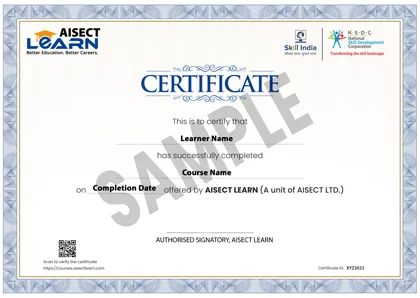
Shareable Certificate
Other Details
Object Oriented Concepts using C++
 Level
Level  Credentials
  Fees
Fees Get Job Assurance and JumpStart your career as Web Developer




FAQs
-
C++ is a programming language that was developed as an extension of the C programming language. It supports object-oriented programming (OOP) and provides features like classes, inheritance, and polymorphism. C++ is widely used for developing high-performance applications, system software, game development, and more.
-
To learn C++, it is beneficial to have prior knowledge of programming fundamentals and concepts like variables, control structures (if-else, loops), and functions. Familiarity with C programming can also be helpful, as C++ is an extension of C.
-
C++ offers several powerful features, including: Object-oriented programming (OOP) concepts like classes, objects, and inheritance. Strong type checking and static typing. Support for generic programming with templates. Exception handling for handling runtime errors. Standard Template Library (STL) for data structures and algorithms.
-
C++ is a versatile language that can be used for various purposes, including: Application development: You can create desktop applications, system software, and other types of software using C++. Game development: C++ is widely used in the gaming industry due to its performance and low-level control. Embedded systems: C++ is suitable for developing software for embedded systems, such as microcontrollers and IoT devices. High-performance computing: C++ allows for efficient memory management and optimization, making it suitable for scientific and computational tasks.
Reviews
No reviews yet.
 Instructor:
 Duration:
 Lectures:
Course Credit:
Lectures:
Course Credit:
 Videos:
 Certification Body:
 Language:
 Access:
Shareable Certificate:
Access:
Shareable Certificate:
